Rick Borch’s lasting impact on Purdue and the department that bears his name
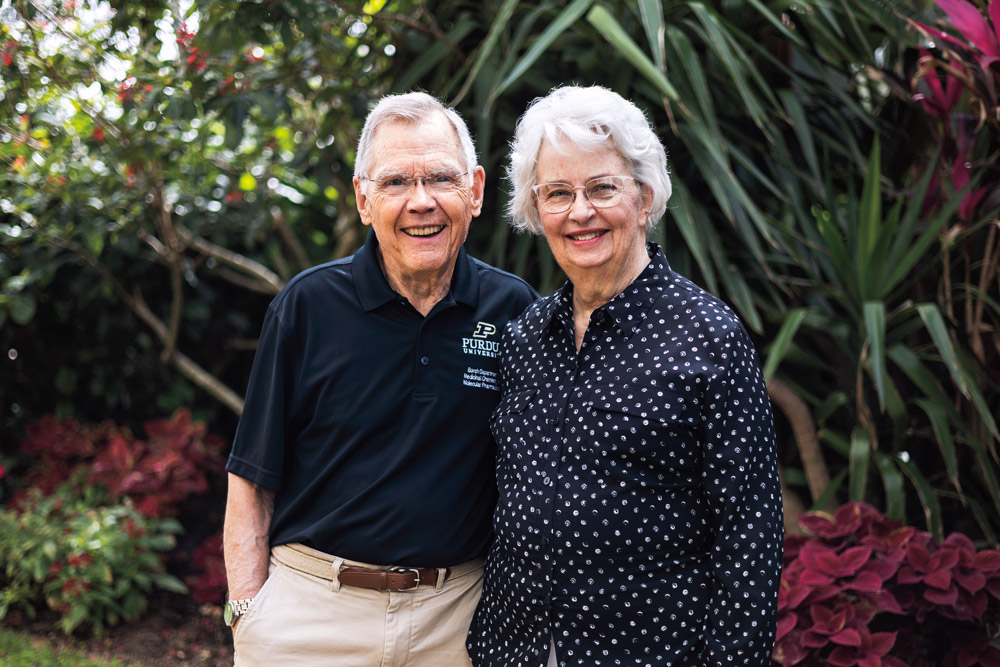
Rick and Anne Borch (Purdue University photo/Gerry Robiños)
Richard ‘Rick’ Borch didn’t set out to become a Boilermaker. Then again, he also couldn’t have known he’d meet his future wife in the ninth grade or that his mother’s cancer diagnosis would lead him to an MD degree—after completing his PhD—that would eventually propel him to the helm of an academic department merger.
Borch, a distinguished professor and department head emeritus of what is now known as the Borch Department of Medicinal Chemistry and Molecular Pharmacology in Purdue University’s College of Pharmacy, was born in Cleveland, Ohio, the grandson of Finnish and Danish immigrants. It was a job transfer for his dad that landed him in the same Connecticut high school classroom that Anne Wilson would transfer into their freshman year.
As Anne recalls, Borch “was the annoying guy that had all the answers in math class.”
They seemed to overcome that hurdle; however, and after Anne finished her undergraduate degree at San Jose State, the two were married. As it turns out, Borch’s mathematical and scientific prowess would eventually play a role in his journey to leading the department that now bears their name.
Borch, who earned his bachelor’s degree in chemistry from Stanford University and his master’s and doctoral degrees in chemistry from Columbia University, was working as a professor of chemistry at the University of Minnesota when he received a life-changing phone call. His mom had been diagnosed with Non-Hodgkin’s Lymphoma.
“Of course, I knew what that meant,” he says. “In those days the chemotherapy for that disease was just barely getting started, so that was not a good prognosis.”
Borch’s mom passed a year post-diagnosis, and it was her journey that ignited his passion for cancer therapeutics research.
“I had a chance to talk with her doctor many times and he just bemoaned the fact that they didn’t have any good drugs to treat cancer,” he says. “I knew how to design compounds. I knew how to make molecules. Maybe I needed to learn more about medicine and figure out how to combine the two to do something useful. That sent me back to medical school.”
Borch completed his MD at the University of Minnesota while also serving on the faculty—a role he’d hold for another seven years before moving to the University of Rochester Medical Center. He later became director of the URMC Cancer Center, a position he was serving in when Purdue first called.
In the fall of 1995, Don Bergstrom—then, associate director of the Purdue Center for Cancer Research—called to recruit Borch to West Lafayette.
“Purdue was planning to merge the departments of Medicinal Chemistry and Pharmacology and, because my research program included both areas, Don felt I would be the perfect department head for this new endeavor,” Borch says.
But the timing was off, so Borch said no.
Six months later, with no ideal candidate in mind, Bergstrom called Borch again. Things were different this time and by October of 1996, Borch was the head of Medicinal Chemistry and Molecular Pharmacology at Purdue. A year later, he was also tapped to lead the Center for Cancer Research (now known as the Purdue Institute for Cancer Research). For a decade, he served as both department head and cancer center director, ran a well-funded research program, and had teaching responsibilities in the Purdue College of Pharmacy and the Indiana University School of Medicine.
After turning over the reins of the cancer center to new leadership in 2007, Borch continued as department head until his retirement in 2014.
A TRIO OF SCHOLARLY GIANTS
Just one year into Borch’s 18-year tenure at Purdue, the College of Pharmacy, under the leadership of Dean Chip Rutledge, started looking to bolster its pharmacology program.
“A major faculty recruiting effort in pharmacology was initiated with the expectation that we might find one—or at most, two—strong candidates,” Borch said. “Remarkably, we identified three outstanding individuals for this position.”
The three candidates were so strong, in fact, that the faculty couldn’t reach consensus. Knowing Rutledge as a risk-taker, Borch decided to take a chance on convincing him the college needed all three.
“I argued that, although I was authorized to hire only one person, I thought we should make offers to all three,” Borch said. “We would be fortunate to recruit one of them and, if we focused only on one at a time, the other two might accept positions elsewhere in the meantime. Furthermore, the chances were remote that we would be successful at attracting more than one of them.”
Rutledge acquiesced, and to everyone’s surprise, all three accepted their offers.
The three: Eric Barker, now Purdue’s Vice President for Health Affairs and the Jeannie and Jim Chaney Dean of Pharmacy; Val Watts, now Pharmacy’s associate dean for research and a professor of medicinal chemistry and molecular pharmacology; and Greg Hockerman, now associate head and professor of medicinal chemistry and molecular pharmacology.
“Eric, Greg and Val accepted our offers, initiated an immediate transformational change in pharmacology at Purdue, and have each made outstanding contributions to Purdue over the past 25 years,” Borch says.
This faculty recruiting class also set the tone for what continues to be a college mindset and priority of recruiting and retaining outstanding faculty. During Borch’s tenure alone, he recruited a total of 24 accomplished medicinal chemistry and molecular pharmacology faculty members — many of whom continue in faculty and leadership roles today.
Additionally, Borch chaired the search for a new Purdue University provost under former President Martin Jischke, recruiting Sally Mason (MS Science ’74), another academic and scientific powerhouse and the university’s first woman provost.
INVESTING IN THE FUTURE
Borch’s contributions to Purdue didn’t stop at scholarly and recruiting excellence. In 2010, on what would have been his dad’s 100th birthday, Borch and Anne, through a generous donation, endowed graduate student support and created the Martha and Fred Borch Chair in Cancer Therapeutics. The endowed chair is a nod to his mother’s cancer battle and his father’s ties to Purdue. Fred Borch was a good friend of Frederick L. Hovde, Purdue president from 1946-1971. Hovde had made it known he hoped the younger Borch would one day be a Boilermaker.
“Early in my academic career at Minnesota, the two Freds met on multiple occasions,” Borch said. “Fred Hovde would say to my dad, ‘Why doesn’t Rick come to Purdue?’”
Borch recalled that when he finally answered that mid-’90s call from Bergstrom and agreed to an interview at Purdue, he couldn’t help but chuckle about how “the two Freds” might feel about the moment.
“When I entered Hovde Hall earlier that afternoon, I noticed the magnificent portrait of Fred Hovde in the entryway,” he said. “I suggested that the two Freds were up there somewhere having a good laugh about my sitting there in the Purdue president’s office.”
CREATING LASTING IMPACT
Borch retired from the department that now bears his name in 2014, holding 20 patents related to potential cancer treatments, and having made decisions and hires that have completely changed the trajectory of his former department, the College of Pharmacy and Purdue University as a whole—an impact Barker said can’t be overstated.
“Purdue University and the College of Pharmacy would be a much different place if not for Rick Borch,” Barker said of his mentor. “He has been a role model of a scientist, an educator, an administrator and balancing multiple hats. He has been a mentor — someone I know I can go to, who has always been willing to dish out tough love and advice I could trust.
“His lasting impact at Purdue has most notably occurred through the people he has invested in — the ripples in the pond that continue to occur because of what he started. There are still good things to happen on this campus from the people he recruited.”
And, according to Borch, it was a series of chance happenings that landed him at Purdue.
“I have talked many times about all these little ‘what ifs’ throughout life,” he said. “It’s just amazing how things work out. It really is.”
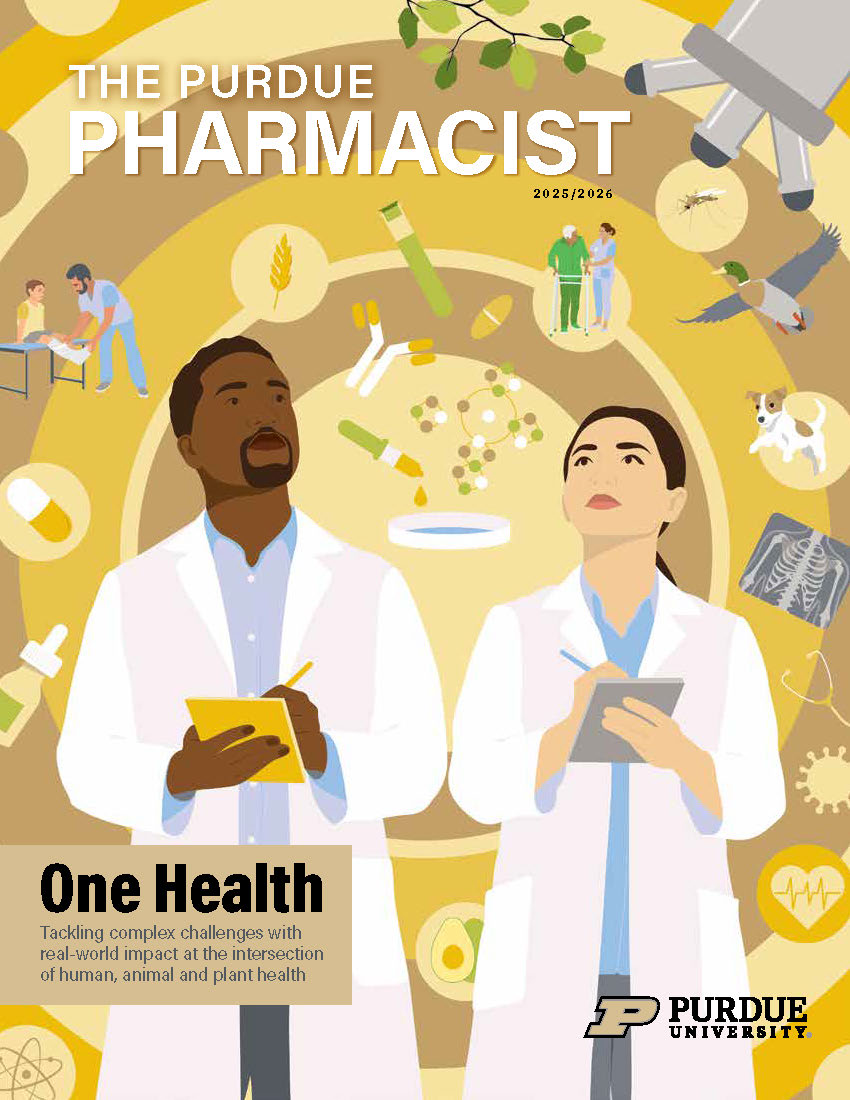
The Purdue Pharmacist
This story, authored by Jennifer Stewart-Burton, director of communications for the Purdue University College of Pharmacy, first ran in The Purdue Pharmacist magazine. This full-color publication is published annually to tell the stories of the world shakers and gamechangers who call the Purdue University College of Pharmacy their home.